Next week kicks off a three-day multi-state conference to be held in downtown Youngstown on the subject of sustainable energy and economic development.
The topic is a trendy one at the moment in technology-based economic development, but a good one, because if you anticipate where the puck is going - or where the Obama administration will be allocating billion of dollars in the near future - it's in the sustainable energy field.
Sunday, June 21 begins with the airing of the FUEL film on the YSU campus at 4pm (open to the public), followed by a Q&A with film's Director.
Monday, June 22 features introductions by the Mayor, Dr. McCloud, and the President and COO of the Parsons Corporation. In 2008, Parsons had 11,600 worldwide employees and over $3.4 billion USD in revenues.
the Keynote Address will be by Congressman Tim Ryan, Appropriations Committee, on the Energy & Water Subcommittee (jurisdiction on the Dept of Energy, Dept of Interior, etc)
a series of what looks like policy and planning discussions to follow during the rest of the day.
Tuesday, June 23 reviews regional research and advancement in the fields of biofuels, carbon management, energy conservation, renewable energy, hydrogen systems, and geologic sustainable energy.
Contributing partners include Parsons, Battelle, NETL (national laboratory), NorTech, the Mahoning/Shenango Advance Manufacturing Initiative, Global Green USA, and the U.S. Business Council for Sustainable Development. From a 40,000 foot perspective, quite a lineup.
So when people are curious as to different approaches to economic development occurring in the Valley, here is a great example.
Last week, the National Science Foundation (NSF) released its most recent statistical tables for research and development (R&D) expenditures in science and engineering (S&E) at universities and colleges across the country.
This data allows us to peer into funding trends at local universities up to fiscal year 2007.
Funding to universities for research can come from a variety of sources: the federal government, state and local governments, private companies and industry, foundations, and the universities themselves.
Here then is a chart illustrating research funding in science and engineering at Youngstown St. University from 2000 to 2007.
The dollar values are in thousands, and displayed are trends for all combined sources of S&E R&D funds (usually the top line), the portion from the federal government (middle), and the portion from industry (lowest line):
The graph shows R&D funding at YSU in recent years had peaked back in 2004 at $1.8 million, dropping by 2007 to almost $600,000. Federal funding too experienced this growth and fall, while funding from companies consistently hovers around or less than $100,000.
Now looking at our friends at Cleveland St. University, the overall trend in S&E R&D funding on that campus is definitely upward. Total funding peaked as well in 2004, at $16.9 million, which is about 10 times that of YSU.
Next up is the University of Akron, which has experienced dramatic increases under the tenure of President Luis Proenza. The last six years of total S&E R&D funding on the chart has U of A in the $27 to $29 million range consistently.
We can also compare trends for the universities side-by-side:
The data for YSU also allows us to delve into the subjects being funded. For example, out of the total $611,000 attained by the university in 2007, according to the NSF:
- $9,000 went to the environmental sciences - $156,000 went to the life sciences - $7,000 went to the math/computer sciences - $375,000 went to the physical sciences (chemistry, physics) - $1,000 (approx) went to psychology, and - $59,000 went to engineering
In 2007, the state of Ohio was ranked 7th in the nation with $1.81 billion in science and engineering research funding to universities. More impressively, Ohio ranked fourth in the percent increase (42.5 percent) in this amount for the five-year period from FY03 to FY07.
Looking only at total funding in 2007 to public universities in the state: - $720 million at Ohio State - $376 million at Univ. of Cincinnati - $52.4 million at Univ. of Toledo - $49.7 million at Wright State - $38.7 million at Ohio Univ. - $27.1 million at Univ. of Akron - $23.7 million at Miami Univ. - $19.0 million at Kent State - $16.8 million at Air Force Inst. of Tech. - $15.9 million at Cleveland State - $9.1 million at Bowling Green - $5.0 million at NEOUCOM - $2.3 million at Central State - and $611,000 at YSU
To be sure, tracking research expenditures is only one simple component of measuring the overall complex impact of a university. In addition to economic development, a university improves the workforce, quality of life, community service opportunities, and the arts, among others.
Reasons for lower relative research rankings over the decades at YSU to other Ohio public universities can be a result of several factors:
- only two programs are currently offered at the PhD level (none in STEM) - historically smaller science and engineering masters degree programs - fewer connections to existing industries from earlier decades - smaller metro and university size - lack of metro-wide economic development strategy and implementation - poor governmental leadership at federal level prior to this decade However, that's the past - and time to move to the future.
According to this recent video taken by the Business-Journal of YSU President David Sweet, the mission of university has been updated, and has undergone a reclassification by the state as an urban research university:
In closing, what will the future hold?
Some important steps have been taken in the past few years, which may impact YSU's future opportunities to grow their R&D expenditures: - the establishment of a STEM (science, technology, engineering, mathematics) College as one of the university's academic units, along with its new leadership;
- the continued growth of local tech companies in the downtown;
- additional engagement with institutions in Pittsburgh, Akron, and Cleveland;
- enhanced partnerships with regional companies;
- leadership at the federal level that understands real economic development;
- the potential for state and regional leaders, and local citizens, to get on this train and not sit on the sidelines.
Kudos and thanks must be given to those leading the larger-scale renovation projects in downtown Youngstown.
This includes the multi-million conversion of the 12-story Realty Building built in 1924 into housing, the recently-announced $8.6 million renovation of the YWCA on Rayen, and the $4 million project to renovate the Harry Burt/Ross Radio Building into the Mahoning Valley History Center.
This progress must also act as a lesson to those to wish to see other historical structures demolished which are in need of repair.
Redevelopment takes time (and money), but patience is needed. For the results are glorious.
The sins of the premature demolitions of terra cotta clad structures of McKelvey's and the Palace Theater, for example, serve as reasons to cautiously proceed as calls exist for the total demolition of the still-standing-but-endangered Paramount Theater, the Kress Building, and the Stambaugh Building.
With that editorial out of the way, let's jump into the future of the Burt Building:
Built in 1919, the original structure was purchased and renovated in 1921 by Harry B. Burt. Burt converted the four-floor structure into a working ice cream factory, restaurant and ballroom space.
The building however is best known as a place of innovation - as the ice cream on a stick, or the Good Humor Bar, was invented and patented in Youngstown.
But in the years to come this gateway to the future will be the home to the newest structure of the Mahoning Valley Historical Society.
Kicking it since 1875, the MVHS has a great website what can explain in further detail the history of the Good Humor Company and they maintain a stellar blog as well.
Above and below are two view of the future development of the building, identifying the space for future archive and exhibition spaces, a renovated ballroom for special events, and meeting space.
After Burt's death and the sale of the Good Humor Company, in 1935 James Ross purchased the building where it remained the headquarters of the Ross Radio Company until 2007.
Another very interesting point of history took place in this building after World War II:
In the basement where Burt's ice cream was once frozen, in order to assist the fledgling zionist movement in Palestine, supporters of the establishment of Israel collected guns and subsequently shipped them to the Middle East to be used by settlers.
Looking in that basement today, we find some neat stuff.
Survival saltine crackers were recently unearthed, and here are some other photos:
On the second floor is the ballroom, still intact from Harry Burt days. Check out those columns.
It was also known as "Club Vogue" back in the day, but this wide shot shows the lack of structural supports which really opens up the space as a dancing area.
But how is the second floor supported?
From the third floor, these supports come down to carry the load of the second floor ceiling.
Nice engineering work, and a nice view out the window:
an old sink:
the Peacock Room, where patrons were once served:
a old-school speaker:
and finally, a non smoking sign from the Harry Savasten mayoral administration more than fifty years ago.
So if you like what you see and support its future, donate to the campaign to transform this building.
As promised, here are the final architectural plans for the new Williamson College of Business in downtown youngstown:
The photo above shows the entrance on the side of the building closer to campus, specifically the entrance closer to Hazel Street extension.
Now below is the site plan of the ground floor:
There are two auditoriums (in orange) on the ground floor, one at each end.
A central atrium splits into two hallways depositing to Wood Street on the side closer to the central business district. One exits to the pedestrian staircase along Phelps Street, the other runs inside parallel to Hazel Street.
The photo below is looking from beyond Wood Street, towards the central part of campus. This is the part of the building along the ridge as the elevation changes, that one that people will see when looking from down below near Cedars' parking lot.
Looking from a similar, but not identical perspective, were we see all the southernish facing windows from the atrium.
The third and top floor in this view shows the conference center.
The views from inside the conference center will have stunning angles of the skyscrapers downtown.
The next view shows the strong design element framing the space from the Hazel Street side.
Below is a cantilevered section, with the name "williamson" in galvanized steel supporting the load.
And below, from inside the atrium - with entrance to the trading floor.
Notice the walkways and stairways that face the atrium, leading to a kinetic feel of the building as people walk through it (and even to the bathrooms).
And here's a handsome fellow with a soulpatch, checking out the letters. This view is looing up towards the central campus.
When finished in summer of 2010, the LEED-gold certified building will double the size of the current building - and be a signature piece highlighting the successful cooperation between the city and the university.
Work began mid-August on the demolition of five structures between downtown youngstown and the university on the hill, whose former footprints will be the location of the new Williamson College of Business building.
Here's a photo of the site taken yesterday:
You can also track the day-to-day progress of the construction of the new $34.3 million certified LEED-gold building here:
"Youngstown Mayor Jay Williams said partnering with the university on the project is exceptionally beneficial because it will not only vastly improve a blighted area on the perimeter of downtown, it also will create a magnificent and powerful linkage between the city’s central business district and the university campus.
The new Williamson College of Business Administration will be a three–story, state–of–the–art facility bounded by Wood Street on the south, Rayen Avenue on the north and Phelps Street on the east. The building will be just east of St. Columba Cathedral and the Catholic Diocese of Youngstown."
be on the lookout in tomorrow's blog for the final design plans of the new building.
"even all the forks passed out by the food vendors will be made of biodegradable potato starch."
it's amazing what passionate individuals with dedicated sponsors can put together.
wow.
while I encourage you go to Youngstown Moxie's site to see the full schedule of activities, here is a quick sample of things at the first-ever Grey to Green Festival at Wick Park (north side 44504) in Youngstown on Saturday, September 13th:
farmers market live music ethnic food belly dancing instruction compost instruction tai chi instruction puppet shows children's activities every half-hour
- - -
And as a special treat, Grow Youngstown is teaming together with the Shout Youngstown blog to present the demonstration:
Urban Permaculture: What is it?
The time: Saturday 4pm to 5pm, Sept. 13th The place: right next to the Wick Park Pavilion The presenters: Tracie Haynes and Brad Masi of the New Agrarian Center.
This talk is supported by the Cleveland-Pittsburgh-Youngstown Regional Learning Network.
The Mahoning Valley Historical Society (MVHS) will be expanding its operations to create a new History Center downtown. The 132 year old organization recently purchased the 22,000 sq. ft. Burt Building (continuously occupied since 1935 by Ross Radio) for renovation. It was at this location that Harry Burt first produced his patented invention in the early 1920s: the “Good Humor” ice cream bar on a stick, now famous all over the world.
(photo courtesy of the MVHS blog)
The History Center will include: - permanent space for exhibits and education - climate controlled storage and conservation facilites - exhibition space for traveling history shows - downtown space for community activites and group events
This building is in great shape. Lots of untouched furnishings from when the building operated as a candy and ice cream factory, retail store and public dining area many years ago.
Their archives are a wonderful place to vist any weekend.
BONUS HISTORY TIDBIT: follow how the Good Humor brand was purchsed from Burt's widow after his death and shifted from corporation to corporation over the past 78 years here.
Stuck in the freeze-frame from this uploaded video with a shot of Youngstown's representatives, here are some highlights from the inaugural gathering of the Great Lakes Urban Initiative (GLUE) in Buffalo:
Yesterday morning, a new organization named "Treez Please" planted a red oak (Quercus rubra for you Linnean types) in Wick Park on Youngstown's historic North Side.
Local citizens heard from Arborist David Sturtz about the proper techniques of tree selection and planting. And in this effort, a truly grassroots organization took their first step forward in their quest to beautify the Mahoning Valley.
Their next project will be the creation of "pocket parks" in local neighborhoods that combine landscaped greenspace and eco-friendly sod furniture. They have aquired a few pieces of property on the North Side, and are beginning work on a parcel on Broadway between Elm Street and Wick Avenue. Check out this photo for an example:
Treez Please will have their next meeting [which open to the public, please attend] this Thursday, September 20th at 5:30pm at the First Unitarian Universalist Church on Elm Street. (go to their webpage if you need directions - it's on the east side of Wick Park).
All donations to Treez Please are tax-deductible.
Besides monetary donations, they are in need of topsoil and dirt to provide fertile ground for the greenspace to develop, as some of their sites have the remains of houses that have been demolished on them. They also could use your ideas, your energy, and your time as they progress with their vision.
For more information contact Debra Weaver at 330.744.1748 or debraweaver2000 (at) hotmail (dot) com
Tomorrow (Wednesday) kicks off an important step in the Youngstown 2010 Planning Process - The very first public planning meeting will be held at the D.D. and Velma Davis Education and Visitor's Center at Fellows Riverside Garden (7pm) to discuss ideas about what is currently being called the Garden District.
This neighborhood, the first of nearly 130 within Youngstown City limits to be planned, is bordered on 2 sides by Mill Creek Metroparks. It is also hugged by Calvary Cemetery to the west and Mahoning Avenue on the north.
Public meetings like these are priceless to the City Planning Department as it gives them an opportunity to hear directly from the residents of that area. Without that valuable input, it can be difficult to determine exactly what the best plan for an area is.
If you live in the area, if you don't live in the area, if you want to move to the area, or if you have ever passed through the area to get to Fellows, please try to contribute to this discussion. You can have a say in what happens here.
The format will be somewhat informal, with the Planning Department presenting several preliminary thoughts, ideas, and observations about the neighborhood. These rough ideas are meant to initiate discussions by the public about what may or may not work in this particular neighborhood. From there, the Planning Department will have some material to work with to generate new and improved plans, which will again be presented in a public forum at a later date.
Be there and be vocal.
- - -
In addition (and because it wouldn't be a Youngstown Planning Meeting if they didn't use Youngstown-based technology) participants will be using Turning Technologies' audience response system.
During the presentation, the public will have the ability to voice 'Yay' or 'Nay' the ideas with the touch of a button.
---
'Garden District' Public Planning Meeting
June 27, 2007 7pm
D.D. and Velma Davis Education and Visitor's Center
The adaptive reuse of buildings is a way for the cities in Northeast Ohio to maintain competitive and sustainable neighborhoods. But how should it be done?
We can see this debate in Cleveland, where the community is struggling to figure out what to do with the Breuer building.
In Youngstown we have these same struggles with empty buildings, but handful of recent projects is illustrating that this city is pushing forward with new life for old structures.
An exciting project was announced this week by the Public Library of Youngstown and Mahoning County. It's the $4.6 million renovation of a long abandoned big-box grocery store, which will be completely redesigned into the new 24,000 sq. ft. Southside library.
The creators of the structure, a partnership of Ronald Cornell Faniro Architects of Youngstown and Meehan Architects of Cleveland, are ripping apart the building and incorporating windows at various angles on five sides, permeating the new library with light.
The building will sit at the intersection of Market and Midlothian, an entry point into both Youngstown and Boardman. This project has been called a community center with a library, which will have separate rooms for local organizations to gather. There will be plenty of computers and free wi-fi throughout, a separate space for pre-literacy programs for babies less than 5 years old, a cafe, and books of course. Here is a floorplan of the library.
The design charettes included a separate opinion gathering process for local teenagers, and is one of the signature projects mentioned in the Youngstown 2010 land-use plan.
Instead of the current setup of a monotonous surface of parking and concrete, the space in front of the building will be transformed into a mix of pedestrain walkways and greenspace. When finished next year, library users can walk to such Youngstown institutions as the original Handel's Ice Cream Stand (now 62 years old, and in 32 locations including in Virginia and California) and Scarcella's Italian Restaurant with their homemade spaghetti and meatballs.
In fact, on the Youngstown 2010 site, the Handel's Neighborhood was recently profiled, where you can view a powerpoint featuring homes in the neighborhood and the amenities in walking distance. You can access the profile here.
You can find the website for the library's project here, and a radio show inteview about the project here.
Also referenced on the show was a new media campaign by the Library showcasing various individuals from Youngstown showing their love of reading. They posters are great, and feature a cross-section of the people of Youngstown. Each of the 19 posters can be seen here.
- - -
After years of disinvestment, it is nice to see our neighborhoods fighting back.
Kudos to those who have stayed, and kudos to those who continue to see value in the city.
And to all those in Northeast Ohio and Western Pennsylvania, come give our library system and city and visit.
Project for Public Spaces published an article with the above title in today's Making Places Newsletter. This edition of the newsletter is so thought provoking...I encourage everyone to visit their site and read some of the other articles. I promise you will find them educational and even a little bit funny. You see, carbon emissions aren't really declining, rather this headline is part of the PPS's annual April Fools edition of Making Places (jovially titled Faking Places).
I originally wanted to post a few excerpts from this article, but I just couldn't decide where to split it up. So, I'm posting the whole thing. The following is reprinted from Faking Places, April 1, 2017:
Last week, the EPA released its annual data on US greenhouse gas emissions. For the fifth time in a row, they announced a substantial reduction--to levels not seen since the population stood at half its current size. This represents a remarkable turnaround, one that has confounded all predictions of how catastrophic climate change would be averted.
Technology has not been the main solution--most cars still run on internal combustion. Nor have emissions declined because of widespread economic hardship--real median income has never been higher. Instead, the threat of global climate change has been met by an even more powerful force: a seismic shift in the American Dream.
As recently as seven years ago, American settlement patterns were best described as "sprawling," and nations including China and India seemed poised to follow our lead. The status and material wealth supposedly conferred by big cars and behemoth homes were still viewed as universal desires, leading to ever-more-extravagant private lifestyles. Then, quite rapidly, these trends lost their aura of inevitability.
Americans began driving less and living closer together. The ideal of a ranch home with a two-car garage and a spacious lawn gave way to something more sociable and intimate. More and more people began settling in places with a strong sense of community, where daily amenities could be found within walking distance. Somehow, the public realm had been elevated over private luxury.
As a result, many cities and towns are virtually unrecognizable compared to their former selves. Houston, to name a widely-cited example, is now served by more track-miles of light rail than lane-miles of highway infrastructure. Once known for its reflective skyscrapers financed by fossil fuel profits, it is now most famous for Discovery Green--a public square in the heart of downtown--and the dozens of smaller public spaces that have cropped up throughout its neighborhoods.
Detroit has managed a similar turnaround despite the continuing decline of the automobile industry. Small-scale businesses there have flourished in a tide of re-investment flowing to areas around Campus Martius Park and the city's new network of bike and transit boulevards.
Neighborhoods where poverty and hopelessness prevailed at the outset of the century are now growing in population and economic output, without a significant rate of residential turnover. These changes are taking place from the inside out.
Small towns and rural areas have completely defied dire predictions at the turn of the century that they were destined for abandonment. Instead we find small growers, many of them recent immigrants, becoming more numerous every year, supported by the continuing boom of local farmers markets.
Even suburbs are being transformed with infill development and new transit systems. For the first time since the (Bill) Clinton Administration, Americans feel more optimistic about the prospects of their children's generation than they do about their own.
Many theories have been proposed seeking to explain how both global climate change and a crippling energy crisis were averted. The favorite among most commentators is to point out federal legislation such as the Healthy Places Act of 2013, or President Richardson's mandate to reduce Vehicle Miles Traveled (VMT) by 50 percent in 25 years, which introduced new incentives that directed resources away from sprawl-making and towards Placemaking. But how then to explain the near-simultaneous change in direction that swept China, India, and mega-cities throughout Africa and South America?
Indeed, the conventional narrative of top-down action tells only part of the story. If you talk to the people who actually drafted the laws, they will tell you the credit belongs elsewhere. That, as important as their efforts have been, they were merely latching on to a social movement already in progress.
"My constituents were trying so hard to mold their communities into better places to live, I just wanted to make it easier for them," says Congresswoman Donna Jacobsen (D-Texas), who represents the state's 18th Congressional District in Houston. "They were heading in this direction whether we greased the wheels or not."
Those in the know cite the release of The Value of Place in 2011 as a watershed moment. This document, the result of years of painstaking research compiled by teams of planners, architects, economists, and sociologists, was widely influential in transforming how local and state governments planned new development and invested in public institutions.
The report summarized the effects of demonstration projects that took shape in five metropolitan areas simultaneously: New York, Dallas, Minneapolis-St. Paul, Tallahassee, Florida, and Bend, Oregon. Multiple sites were selected in each, carefully chosen to provide a comprehensive baseline of data. The selected places ranged from centrally located downtown squares to small parks to commercial main streets, in neighborhoods that fully represented the nation's cultural and economic makeup. Each professional discipline brought their skills to bear at each place, working side-by-side with local stakeholders.
Factors including vehicle miles traveled, pedestrian activity, local economic growth, obesity rates, and depression rates were measured obsessively before, during, and after implementation. Because the demonstrations were conducted gradually, and involved no big names or outsized projects, they attracted relatively little attention in the press at the time. But the evidence that emerged--which showed strong correlations between public space improvements and the positive outcomes observed--left a strong impression in many minds.
"When that report came out, it really grabbed the attention of local governments," recalls Senator Joe Riley (D-South Carolina), the former longtime mayor of Charleston. Indeed, soon many municipal governments were completely transforming the internal operations of their agencies. The boundaries that had kept different professions operating in isolation from each other started to buckle and fall.
"I think we were aware that this project could have a profound impact on climate change, but that was never our primary goal," says Meg Walker, co-chair of Project for Public Spaces, one of the organizations that spearheaded the research. "We were asking how cities and towns could foster more social interaction, a greater sense of connectedness between people. Depression and isolation were epidemics in this country at the time, and we attributed a lot of that to the fact that people didn't have much choice but to live in physical environments that limited their options—what to do, how to get around. We knew if people could free themselves from that situation then a lot of the rest would follow."
The success of the first experiments attracted funders who were interested in replicating the results in other cities and other nations. "People saw that this work had very broad applications," says Manuela Garcia, a program officer at the Gates Foundation. "Government reform, public health policy, economic development, you name it."
She ticked off a list on her fingers: "Your street network, your public institutions, your retail businesses, your waterfront, your parks and greenways--none of these exist in a vacuum, and they all converge at physical places. So once you change the frame of reference and start thinking about interconnected places instead of separate systems, then you can start shaping cities in ways that very tangibly improve many different aspects of people's lives. And once you've shown people what that looks and feels like, they want more of it; they want to become part of the process."
The widespread appeal of this approach to building neighborhoods, towns, and cities is quickly apparent in maps of settlement patterns around the world. The unmistakable trend for the past five years has been the growth of population centers and the decline of spread out development. Not all of these new concentrations are mega-cities. In fact, most are small towns and suburbs that have shifted away from the old sprawling forms and towards something more city-like, where walking and transit are the preferred modes of transportation. You can credit new laws and regulations for bringing this change about, but the truth is it never would have happened if most people didn't want it to happen.
A fascinating new set of ideas about urban design in Youngstown appeared this week on a special website of Kent State’s Cleveland Urban Design Collaborative. Students from the architecture faculty at the Dresden Technical University in Germany produced some truly stunning concepts for the possible future of design in the city.
Their work encompassed two geographical areas in the city: the Crab Creek river basin and the land adjacent to the convention center downtown.
The Crab Creek runs south from Trumbull County separating the north and east sides of the city, eventually merging with the Mahoning River near the downtown. Miles of industrial property runs along banks of the Crab Creek, which currently has no public access. Their plan includes opening the river to the public again by incorporating features such as pedestrian and bike trails, an “industrial garden”, and an “adventure site” for younger children. You can see their entire presentation here.
I really like the industrial garden idea. It includes illuminating old loading hoppers along the river as a central focal point, incorporating old railroad ties for benches and landscaping, and reusing older buildings for restrooms and meeting and exhibition spaces.
The second presentation (found here) includes ideas for what to do with the land sandwiched between the Market Street Bridge and the South Avenue Bridge near the convocation center. It included building a ramped walkway to the river above the railroad tracks and an amphitheater among others.
One additional presentation on the website gives an overview of the reuse of industrial property in the Emscher Area of the Ruhr Valley. Remember my World Cup blog last week about the area around Essen feeling like Youngstown? – well this presentation backs up that idea. It includes examples of using creative lighting, recreational areas, residential developments, and commercial successes to enhance existing industrial areas.
They close with these important conclusions:
- derelict industrial areas have value - protect existing structures - new uses are essential - new implementation methods are needed - establish a financial framework before beginning - place emphasis on long range solutions
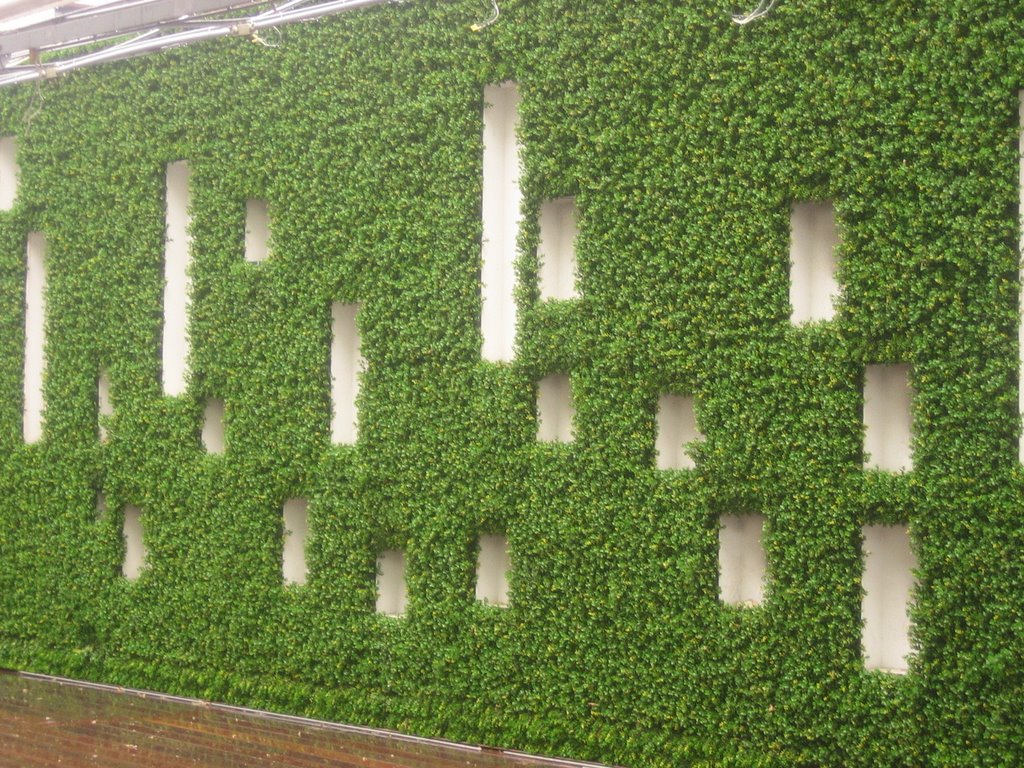
Walking along Sherbrooke Avenue in Montréal, I came across an interesting wall. Ivy was growing across the surface, except for randomly assorted spaces.
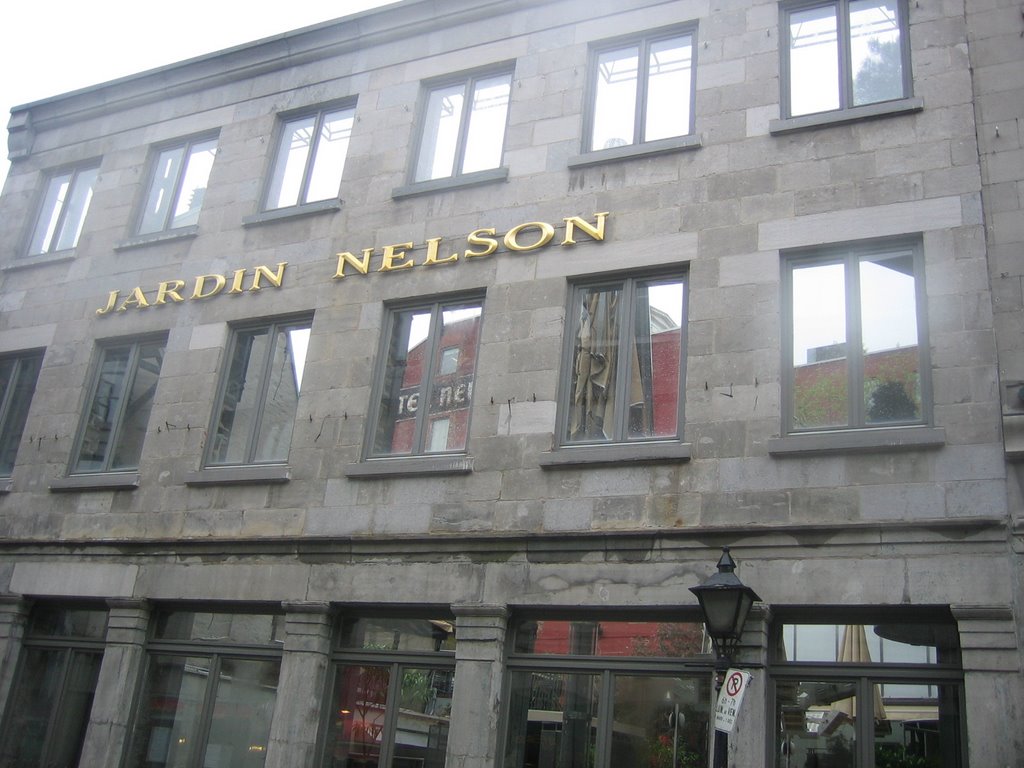
Taking a step back, this wall was part of an outside patio for a local restaurant. A creative use of nature in an outdoor commercial space.
Here is another cool example in the same city. The facade of this building was at one point saved, and now functions as a wall separating the sidewalk from the dining public. Another great example of adapting older buildings for reuse.
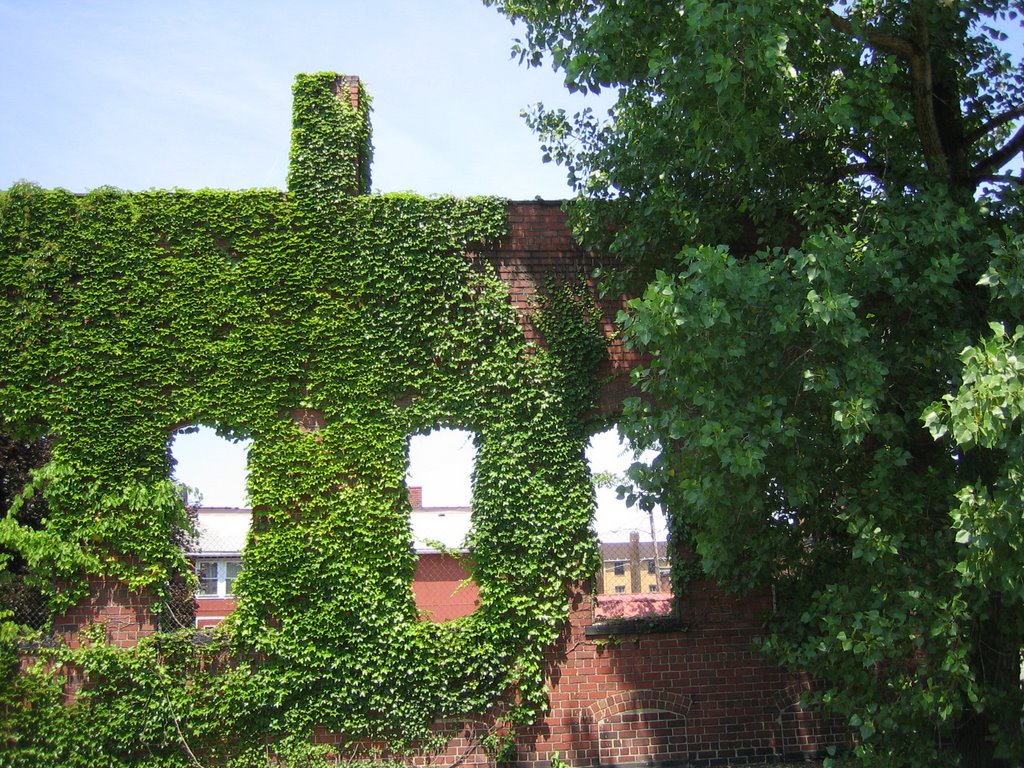
This last picture was taken by myself in downtown Youngstown:
Some may call for this building to be torn down. But as we see in other cities, we can adapt our structures for new usage before destroying them. Can the space be structurally supported and illuminated? Maybe flowers can be grown along the surface...
There are many functions this type of space can serve as we hold onto our historical character.