Tuesday, January 30, 2007
Thursday, January 25, 2007
can volunteers and technology help to fix the city schools?
This "right to a quality education" has recently become a hot topic in the Buckeye State, as there are groups pushing to edit Ohio's Constitution to make this right to a quality education the law of the land. Pho in Akron does a nice job of recapping this issue, as well as providing links to editorials and judicial opinions at his recent posts here and here. Really nice work, Pho.
So while this blogger will leave to it the reader to further explore the arguements about the amendment, a central question needs to be answered:
Are there steps that we can take to minimize the existing inequalities?
Furthermore, are there cost-effective solutions out there to avoid what some callers to the show labeled "throwing more and more money into a broken system"?
- - -
So while the following two suggestions may only chip away at small pieces of the problem of inequities instead of solving the entire state's school system, maybe that is the best place to start.
Because even the longest journey begins with a single step.
a - I know a few retired schoolteachers. Thirty years of being in a classroom has not only made them experienced teachers, but also employees who are well-deserving of a retirement.
Some of these teachers however, have gone back to volunteer for free in the schools, if only for a few hours a week.
It's my bet that there are many many retired teachers throughout the region, and a lot of them can still make a difference in children's lives. But instead of placing them in a classroom with twenty-five or more kids throughout an entire school year, is it possible to match a single teacher with a single city school student for two hours a week?
Maybe a neat pilot program would be to create after-school meetings for academically troubled school students matching teachers who may be willing to provide a few hours a week of tutoring, and even perhaps some inspiration and personal guidance as well.
But then, why stop at teachers? Can our region's engineers, artists, accountants and machinists - our region's individuals - provide two hours of mentoring one day, every other week, to one student?
If loads of people can help in this fashion of incremental assistance, then perhaps a unique safety web and source of inspiration can exist for every city school student who needs it.
b - A great organization I had the opportunity to work with in the past was TECH CORPS in Georgia. Their goal was to minimize the digital divide that existed for inner city school children who lack an exposure to computers throughout their lives.
Volunteers would sort through donated and discarded computer equipment, often installing software and performing upgrades before giving the computer to the families of city school students who did not already have one. The organization also provided training for the entire family to learn basic computer skills, skills that are essential to future employment in many sectors of today's economy. That way, the children can work with computers not just during the short time of the day they are in school, but in their home as well.
So then I checked the web if this group is in Ohio. And sure enough, they are. And they can be found at this website.
But the interesting thing is, the group is not statewide. It only operates in 10 out of Ohio's 88 counties, none of which are in the Mahoning Valley.

But they would like to expand their presence in the state! Click here for more details on their long-range hopes for the group.
So maybe the next step is to find out what we can do to help TECH CORPS Ohio expand into our region. To help us get organized in this area, to train volunteers, and to eventually provide students with computers they can use, and to develop a more highly-skilled workforce for the future.
Are you looking to volunteer with an organization? Maybe TECH CORPS is a good place to start, and your assistance will have a big impact on the future.
- - -
The Rivers' show ended with an interesting discussion, asking Sracic what he sees in this region that others who live here are not aware of. Sracic's response was that the Mahoning Valley still has a great sense of community - a tight-knit community that other parts of the country just don't have.
So perhaps this same community can rise up and say "you know, there are just some things that the state and property taxes can't alone solve" and it is up to individuals who volunteer their time which bit by bit, can start to make a difference in the inner city schools.
-
-
-
quick news note:
Michigan is experiencing some pains at the moment as Pfizer announced it will be closing their operations within the state, effectively laying off thousands of workers. You can read two stories about what happened here and here. It just goes to show how turbulent the economy is sometimes, and the churn that exists even in high-tech industries.
Let's hope Michigan quits losing jobs like these, and instead returns to something they are really good at losing . . .
namely football games.
Sunday, January 21, 2007
two more 2010 mentions, and a new website
Well . . there are three new things in Youngstown to blog about.
That's what.
- - -
a - The first is a story in today's edition of the Pittsburgh Tribune-Review titled, "Extreme Makeover: City Edition." Justin Vellucci writes about the economic shock to Youngstown following the collapse of the steel industry and the abandonment of many residents and commercial businesses, eventually describing how the 2010 plan is planting the seeds for a sustainable city.
Once you get to the page, click on the Multimedia Slideshow:Youngstown link on the upper right side. There, mixed among pictures showing the removal of blight, you will see some nice photos with dialog provided by the mayor. Especially cool are the ones taken in the middle of West Federal Street, and the shots of Mayor Williams standing in the convocation center's parking lot with the city in the background. (note: I was thinking of posting the pictures here, but a friend who works for the Trib told me their legal department is pretty viscious - so check them out yourself from their page)
The piece ends with a comment by Bill Lawson, executive director of Mahoning Valley Historical Society.
"In a large respect, we lost a whole generation of people my age. ... There just weren't any opportunities here. So, people that I know are gone," he said. "These young people (today) are doing it. The future's looking up."
And on that note, the youth are indeed taking a step forward and being noticed:
b- Thanks to the efforts of local rap artist Shug B, the 2010 project has also found its way onto the Mtv2 channel.
Shug B submitted a video about the local music scene to the television network for their show "My Block". Individuals across the country submitted documentaries illustrating their home city. From this year's applicants, Phoenix, Long Island, Seattle, and Youngstown were chosen as finalists.
The television commercials from My Block, now airing on the network, have Mayor Williams talking about the 2010 program. You can jump to the Mtv2 site here, and then you can vote for the Youngstown video an infinite amount of times.
I thought this "infinite amount of clicking" form of voting was a bit strange, but it turns out Ohio-based Diebold is charge of the voting, so they can be trusted.
Speaking of infinite, here is a link to the infinite ohio shoutout.
Cause as cmoss says: "If a tree falls in the woods, and don't noboby hear about it, will it make a noise?"
"No, motherfucker, it don't." . . . "you gotta let it be known."
c - And from the students who organized the meeting last week regarding the State Theater downtown, a new website has been created. Click here to see their work in progress of the "Friends of Youngstown Theaters". What is especially cool is their still growing list on the left side of the page mentioning all of the theaters in town, either renovated, hoping to be renovated, or otherwise.
I especially like their pictures of the Palace, which was a beautiful building. The developers claimed to build a downtown mall and theater complex in its place, but since its demolition in the summer of 1964 for their project, it has been a parking lot.
Let's hope no more of our historical treasures will see the wrecking ball.
http://www.youngstowntheaters.i8.com/
Friday, January 19, 2007
a modest proposal . . .
- - -
A news story highlighted in this week's Columbus Dispatch provides a glimpse at the new approaches to public safety that are being considered within the state of Ohio.
The city council of Upper Arlington, a separate city and suburb of the capital, is considering this week to enact tough restrictions on the ability of convicted sexual offenders to be employed within the city limits. According to the story, Councilman Timothy S. Rankin called for "an outright ban on offenders living or working" within the city.
According to the Police Chief Brian Quinn, there are three Upper Arlington residents (out of 34,000 residents) who are designated sex offenders registered in Franklin County. The proposal, which received no criticism from the entire city council body, could become law in about two months.
Councilman Wade Steen pointed to a large wooded area on a city map during the meeting showing where, "predators are more likely to lurk." Current legislation forbids sex offenders from living 1,000 feet from a school, effectively making two-thirds of Upper Arlington off-limits for habitation.
- - -
so here are three things to ponder . . .
1 - Do these laws, prohibiting where sex offenders can live and work, effectively stop future crime?
It suffices to say there are pedophiles throughtout the country with access to both the internet and an automobile. So what is to stop any individual in the country from going here to find maps for Upper Arlington to see where children go bathing in the summer months, or here to find a list of all the libraries in town?
The laws might prevent future tragedies, and they might not. I'm not sure of the answer. But do these policies provide solutions, or just displace the problem?
2 - What if these laws become trendy in suburbs all across the nation?
Perhaps then entire sections of the country could then be "protected" from the peverted nature of these individuals. We could funnel all of our society's problem-makers into our inner cities, or better yet, in one location somewhere outside of the country. David Singleton of the Ohio Justice and Policy Center asks then: are these laws unconstitutional because they can be considered banishment or punitive?
3 - And finally, if we as a society accept these types of laws, can we extend the employment and living restrictions on other criminals who are now out of prison?
Maybe the cities of Cleveland, Youngstown, and Akron should enact a law which prevents any individual convicted of robbery or the illegal possession of a weapon from living in the city. Or Canton, Lorain, and Warren can all support legislation which will prevent any individual found guilty of selling drugs from working within the city.
Or perhaps Northeast Ohio would become a more idyllic place if we can banish any person, convicted of any crime, from our region.
- - -
something to chew on during the weekend.
I by no means have any of the answers, but it will be interesting to see how the progression of laws such as these affect the future development of cities within the state of Ohio.
For if we can't attempt to solve our society's problems, at least we can displace our problems to future generations and other jurisdictions.
Wednesday, January 17, 2007
from the mailbag
1 - In the last two weeks, it seems another four blogs with Youngstown-area themes have come into existence.
The Youngstown History blog
http://www.youngstownhistory.blogspot.com
Blogging Ohio blog - with a new writer for Ytown
http://www.bloggingohio.com/category/youngstown/
The Mahoning Valley Voice blog
http://www.MahoningValleyVoice.com
The Defend Youngstown blog - reviewing news downtown
http://www.defendyoungstown.blogspot.com
2 - A nice little policy story by Rob Atkinson, president of the Information Technology and Innovation Foundation, highlights America's response to past competitiveness threats and what should be done in the future. You can download it here.
The piece made me wonder if there are any R&D tax credits provided at a local level. Or if there are any local policies Northeast Ohio can come up with to match his proposals.
At the least, I feel this is a short article that all people - especially public officials and the folks that sit at home and listen to talk radio - should look over.
3 - And a great comment was sent by Anonymous yesterday as a response to the "Printz Mansion" entry:
"Perhaps a tour of some of the homes in older neighborhoods that are functioning and in good condition will give people a view of what Youngstown has to offer and even push some to purchase and renovate. I wonder if this goes on now or if people who own such homes on the north side have considered the idea before?"
I love this idea. When we went on the tour of the north side homes, it was amazing to see how these homes that were so beautiful on the outside were even more incredible on the inside. There were carvings in the wooden trusses on the ceilings, ornate original stained glass, working fireplaces, etc.
So maybe a group like the North Side Citizens' Coalition can take videos of the inside of these homes, stitch together small movies like the peeps at the Metro Monthly did, and post them to YouTube or to the webpage of their neighborhood's organization . . .
Driving through the nooks and crannies of the northside's streets this weekend along Crandall Park, the neighborhoods near Wick Park, and the homes south of the Stambaugh golf course, I heard these homes calling out: "Hey, look at me! We are here! You don't need to build your McMansions and three bedroom houses in the exurbs/suburbs. We are treasures waiting to be discovered . . ."
Monday, January 15, 2007
the state of the state address
Here is a rundown of the situation:
According to the myspace page of the meeting's organizers, the State Theatre was constructed in 1915 and is the oldest theater remaining downtown. It was renamed the Agora in the 1970s and closed for good in the 1980s. Since that time, the structure has been boarded up, only to be entered by the occasional curious explorer, pigeons, and rainwater. So for about two decades, this historical structure has deteriorated in appearance and structural stability.
Fast forward to January 2007. The property is now owned by the Youngstown Community Improvement Corporation (CIC), a non-profit entity which maintains control over many of the empty buildings downtown. The Youngstown Business Incubator is looking to expand its operations in close proximity to its main building, with ground broken for an adjacent 30,000 sq. ft. space for its growing companies, and hoping to rennovate two additional existing historic structures on the same block.
Under this scenario, every building between Hazel Street and the Home Savings and Loan Building would then have a plan for future function, with the exception of the State Theater and the Armed Forces building next door.
But what to do with these buildings? Some advocate their demolition so the space can be used for surface parking lots. Others advocate their total restoration. Others advocate a compromise between these two extremes.
And it was at this meeting over the weekend that many of these possibilities were discussed. Questions such as "Is the seating section of the theater intact?" and "Has a day been chosen to demolish the existing structures?" as well as "Is the facade worth saving?" were posed by those seated in the audience.
So based upon statements made both during and after the meeting, here is a quick list featuring a wide range of possibilities for the State Theater:
plan a - Rennovate the entire structure, facade and all, back to operational capacity.
plan b - Demolish the stage and auditorium between Boardman Street and the alley, rennovate the existing portion between the alley and West Federal, and keep the facade in place.
plan c - Demolish everything behind the facade, keep the facade in place, and use it as the front of a new building, pavillion, or public space structure.
plan d - Demolish everything behind the facade, keep only a structurally reinforced facade in place, and illuminate it.
plan e - Move the facade to another location in the city and demolish the rest.
plan f - Demolish everything, save nothing, dance on the ashes.
Maybe it is time for members of the public, the staff at the CIC, the stakeholders of the business incubator expansion, and members of the mayor's administration to sit down and listen to eachother's interests. At that point, it may be possible to estimate the short-term costs and long-term consequences of each of the possible plans.
And to be certain, it was exciting to see a diverse group of forty to fifty Youngstown-Americans come together and discuss the future of our downtown, and hitting the streets to explore the landscape. Of the two people who organized this initial meeting, one is a high school student and the other is a freshman in college. It is a small reminder that in the city of Youngstown, both the younger generations and the older generations have the ability to contribute to its future.
Indeed a receptive audience seems to be out there. Keep it coming.
Wednesday, January 10, 2007
new years resolution, er, revolution
But one part of the blog really jumped out at me.
Every time you read the word "Lorain" in the next passage, insert "Youngstown". I did it fot the first sentence.
- - -
If you’re reading the WoM (shout youngstown) blog from some outpost other than Lorain (Youngstown), then you obviously are interested in Lorain (Youngstown) and Lorain’s (Youngstown's) well being. Lorain needs people like you so come back home. We have the lake (huge park), we have seething hot politics, a remarkably inexpensive cost of living and hey you can contribute to the revolution.
Conversely, if you’re reading the WoM blog from a study, bedroom or kitchen in Lorain then you defintely are interested in Lorain and Lorain’s well being. So stay. We need you and your care and your passion about Lorain IN Lorain. Don’t give up. We have just begun the revolution.
- - -
And so the revolution is just beginning in Youngstown.
But it needs your help.
From those both inside and outside the city limits.
We need you, and your care and your passion.
Please go and read the post about Lorain if you have the time. It even has some good links to click on about investment property loans, banking locally, and puchasing property in the city.
and happy 2007.
Thursday, December 28, 2006
4 questions for the kidd
This little "question and answer feature" may become a semi-regular feature on this blog, depending on the response. Please leave a comment what you think of his answers, or who else you would like to see interviewed.
SY: A recent Business Journal article mentions that your heart belongs to Youngstown. Was there a singular event to make you begin to feel this way, or was there a gradual transition that you can further elaborate about?
PK: When I first came to Youngstown as an undergraduate at Youngstown State nearly 10 years ago, I was instantly attracted to the presence of campus and to the upper north side. As time passed, I began to experience and appreciate the Valley as a whole - its depth and layout, its history, and its tremendous sense of community. When I left for the military, I never lost touch with the people I knew from Youngstown or the progress the city was making. Youngstown had left an impression on me like few other places have or could.
I became extremely intrigued by the Youngstown 2010 project and upon leaving the service, I had to make a decision as to where I was going to continue my life. Seeing that the city seemed to be formulating a legitimate plan for its future, I made the decision to return. The decision turned out to be a life changer.
I attended almost every Youngstown 2010 meeting until the plan was officially finalized in 2005. During this time, I met a number of great "Youngstown-Americans", however, one in particular really impressed me. His name was Jay Williams. Some of your readers may recognize the name. When Jay decided to run for Mayor of Youngstown, I realized the imperativeness of the election. We fought incredibly hard to get him elected and, to the great benefit of the city, Jay was overwhelmingly elected Mayor late last year. This solidified my commitment to Youngstown.
I suppose my love to the city has much to do with being a native of Pittsburgh. I view Youngstown as smaller version of the Steel City in the sense that it matches the same values and "realness" attributes that shaped me as an individual. Youngstown is a take-it-or-leave-it kind of town with down-to-earth people who understand the full spectrum of life because they are exposed to some of the best and the worst aspects of life almost daily. In my opinion, that is the real beauty of it all. Despite its problems, the good people it attracts or selects are people who choose to fight the good fight in life. To top it off, Youngstown is also a city that is open to all kinds of possibilities with amenities that many other cities can only dream of. These amenities could only have been provided by being a successful city twice our size a half century ago.
By good fortune, we have preserved these assets well and are rebuilding a new Youngstown around them. It’s a beautiful situation and we are certainly on our way, however, the city has many battles ahead and we need people committed to the fight. I’m a fighter and a believer.
That is why I love Youngstown.
SY: Where do you see downtown Youngstown in ten years?
PK: First off, let me say that I think 10 years is pretty realistic time period to begin to evaluate our progress. I think a lot of people say, “Well, I hear about positive things going on in the city but I don’t really see much change.” It’s a difficult comment to address because much of the “important” things that are happening in the city are more groundwork, city planning-oriented stuff. What we are talking about is building an infrastructure or a model, if you will, in which future administrations can continue to build upon. Obviously, in Youngstown, that requires a great deal of effort because we’ve conducted business pretty poorly for the last 3 decades. So, that, in and of itself, is enough work for any Mayor.
However, when you have severe, pressing social and economic issues that must also be addressed at the same time, you have a complicated situation. But to that end – and this is as big an aspect as any– is our change in mentality or approach in our elected leadership within the city (Jay Williams) and beyond (Tim Ryan). In many respects, this is uncharted territory for Youngstown. We are building as we go. It’s like laying railroad track with the train on the track, moving forward, waiting for the next piece to be laid.
A plan like Youngstown 2010 (which is really in an infancy stage) is a bold new approach to city planning. It’s a very comprehensive and very goal-oriented plan (and now gaining national attention/respect) yet one that is not going to have immediate results. We are essentially shrinking Youngstown, restructuring large parts of it and building on existing strengths. The idea is that Youngstown will become a leaner, greener city, capable of more control over the complex urban issues it faces. Again, this means very good things in time but nothing you’ll see overnight because the changes are gradual but permanent. These changes, in turn, hope to spur the interest of business and industry (among others) across the nation who may consider conducting business in Youngstown if they view the city as seriously committed to reestablishing its community and economy through action.
The target right now, however, is the downtown, and in 5 years you’re going to see some dramatic changes that will make it a true destination in the Valley. In the past 3 years, we have seen the reopening of Federal St, establishment of the Chevy Centre, and an influx of new businesses and restaurants. Within the next 3yrs, we’ll see the opening of 3 major residential towers (Realty, Wick, and Erie Terminal) which will mean you’ll have a mix of professionals and students living in the downtown. In addition, we will see a $250 million community built in Smoky Hollow. That essentially solidifies the downtown as a viable, residential area which is an incredibly important destination.
This will be followed by more retail to accommodate these residents as well as the growing number of people who visit entertainment venues downtown. YSU’s commitment to the Youngstown 2010 plan will also be well underway with the establishment of the business college and the extension of Hazel St (which will serves as the “Federal St to the North”). Establishing true “connectivity” between YSU and the downtown provides limitless options for both parties.
These are major developments which will serve as the foundation of the revitalization effort within the city. Success of these projects will dictate further development of which I’m sure will include a heavy neighborhood focus and the “greening” of much more of the city. The next 10 years in Youngstown will be something this nation will take note of.
Q: If I gave you a check for $10,000 to be spent on the city of Youngstown, what would you spend it on and why?
PK: With $10,000, I’d sink every penny into surface lighting for our current structures downtown. Our downtown architecture is one of our greatest assets yet a number of beautiful buildings remain dark and seemingly hidden. It’s not a quick fix problem and, as I understand it, is one in which our downtown revitalization committee is attempting to remedy (finding funding to lay electric wiring underground to support the utility). However, I would contribute my $10,000 toward that effort.
Q: If you had one last meal left on this earth, and it had to be in Youngstown, what would it be?
Wow. You save the toughest question for last. I could probably think of 30 or 40 places worthy of a last meal in the city, however, my last meal would be a breakfast at the Golden Dawn. I’ve spent most of my time in Youngstown in or around the North Side, particularly the neighborhoods close to the Dawn.
I started there and I’d end it there.
I’d order my usual double order of 2 eggs, ham, and toast with a cup of coffee, write a note stating to “fight the good fight”, hand it to youngest kid in the room and walk out the door into oblivion.
Wednesday, December 27, 2006
youngstown in USA TODAY's cover story
The cover story in today's USA TODAY is about creative shrinkage in cities. Youngstown has a role in the article.

Youngstown, Ohio, is an exception. It has fully embraced its shrinkage. The population, now about 83,000, is less than half what it was when the steel industry collapsed in the 1970s.
"You look at the facts and come up with solutions," chief planner Anthony Kobak says. "The first step the city has come to terms with is being a small city."
Youngstown approved a 2010 plan. The goal: "A safe, clean, enjoyable, sustainable, attractive city," Kobak says.
The city long was better known for gritty steel mills than green space. Now that the mills are gone, there is plenty of space. With the help of a grant, Youngstown preserved 260 acres. It's targeting neighborhoods and redesigning them with the help of residents who stayed.
The city may let homeowners buy abandoned lots next door to create gardens. It's considering relaxing zoning rules to allow small horse farms or apple orchards. It's offering incentives for people to move out of abandoned areas.
"If you had three or four square blocks that at one time had 40 homes per block and now have maybe five homes total, we could relocate those people across the street and convert the vacant area into a large city park," Kobak says.Residents would live be living across from a park rather than being surrounded by decrepit homes and lots overgrown with weeds.
click here for the entire USA TODAY article.
click here to see how other bloggers have covered this topic.
click here for the webpage for the Youngstown 2010 program
+2 kudos to Anthony Kobak for making it big-time
Thursday, December 21, 2006
The Gateway District

Story 2: Market Street is an important corrider that runs through both the City and the Township and both have identified this stretch as vital to their communities' future success.
Story 3: Mayor Williams has expressed interest in using Joint Economic Development Districts (JEDD) "as a way to promote regional, economic cooperation." He has recently appeared on the David Betras Show more than once discussing and debating this economic strategy and its ability to be used effectively in our city. JEDD's are a North East Ohio invention (by current mayor of Akron, Don Plusquellic) that allow a city to receive a portion of the taxes from the development on township property, without the threat of annexation. The result is a mutually agreeable development.
Conclusion: Now, like some Guy Ritchie movie, wouldn't it be great if all three of these story lines came crashing together to create one harmonious and enlightening ending? I see this intersection as having great potential for some sort of development. Do you agree? Maybe there is a different way to create a welcoming gateway into the city that is anchored by a brand new library.
Thoughts?
Wednesday, December 20, 2006
how pimp is this?
Check out this fantastic video with the killer music . . .
And here is a collection of some nice downtown shots at night . . .
And here are some shots of the downtown catherdral after it was struck by lightning in 1954:
thanks to those who took the time to arrange these and upload them!
- - -
But it got me thinking, would the You Tube format be a good way to advertise our neighborhoods as part of the Youngstown 2010 neighborhood plan? We have the pictures of homes, maps, and now national recognition from the APA for the plan. All we need to do is assemble it, add some great background music, and post it online.
Speaking of which, maybe all the Youngstown 2010 broadcasts should be on You Tube in addition to the 45/49
and 2010 sites . . .
Tuesday, December 19, 2006
croatian home, eat your heart out
est gorod Palestrina.
zvezda pereferii, vsa v maslinah, stala nasha malina.
Ya vzmolilsa "Che cazzo! Io porca Madonna!"
These lyrics are crazy.
They were sung by Hutz in Cleveland last night. In case you missed the show, here are some clips of Gogol Bordello, the greatest band of the 21st century.
Saturday, December 16, 2006
the waters of the mahoning
fechando o verão
É a promessa de vida
no teu coração
Friday, December 15, 2006
youngstown in nytimes magazine: an update
is a particularly interesting comment from one of the readers of Pittsblog:
Robert Bruegmann in his book "Sprawl" briefly discusses the growing suburban development around Youngstown, and notes that anti-sprawl zealots (like me, I suppose) point to these communities as evidence of all that is wrong with current development trends. Why are developers throwing up all these subdivisions when you the population of Youngstown proper keeps plummeting? The answer to Bruegmann is that the presence of these communities is the only thing that keeps the remaining middle and upper-middle class families from fleeing the metro area; and eventually, it is these people who are most likely to revitalize the city itself. It's definitely a different take on the relationships of suburbs to cities than many Pittsburgh residents maintain.

Photo courtesy of the Mahoning Valley Historical Society from Metropolis Magazine.
here is a review of blogs out there that reference the nytimes story:
"CEOs for Cities" - Chicago, IL
- - link - -
"Blogging Ohio" - various cities in Ohio
- - link - -
"BLDG BLOG" - Los Angeles, California
- - link - -
"Antirust" - Pittsburgh, Pennsylvania
- - link - -
"Space, Place, and Identity: Brand Avenue"
- - link - -
"Resilience Science" - Montréal, Quebec
- - link - -
"Pittsblog: Learning from Youngstown" - Pittsburgh, Pennsylvania
- - link - -
"Blueprint for New Orleans" - Lafayette, Louisiana
- - link - -
"Reurbanize Buffalo" - Buffalo, New York
- - link - -
"Downsizing Pittsburgh" - Pittsburgh, Pennsylvania
- - link - -
I'll add more to this post as they come up . . .
Sunday, December 10, 2006
youngstown in today's nytimes sunday magazine
As it is many people's custom to read this blog with their cup of coffee and pancakes religiously every sunday morning, maybe this weekend you'll want to do something a little different, and purchase a copy of sunday's new york times.
You see, every December the New York Times Magazine looks back over the year through the "mountain range" of intellectual concepts and ideas, and presents some of them to the world.

This year's version has this article about "Creative Shrinkage" and its subject is Youngstown and the 2010 plan.
some clips from the story:
"Few communities of 80,000 boast a symphony orchestra, two respected art museums, a university, a generously laid-out downtown and an urban park larger than Central Park. "
"[Jay] Williams’s strategy calls for razing derelict buildings, eventually cutting off the sewage and electric services to fully abandoned tracts of the city and transforming vacant lots into pocket parks."
"The city has also placed a moratorium on the (often haphazard) construction of new dwellings financed by low-income-housing tax credits and encouraged the rehabilitation of existing homes."
"Instead of trying to recapture its industrial past, Youngstown hopes to capitalize on its high vacancy rates and underused public spaces; it could become a culturally rich bedroom community serving Cleveland and Pittsburgh"
"Youngstown’s experiment has not gone unnoticed. Williams’s office has already fielded calls from officials in a few of the many American metropolitan areas."
- - -
As indicated in the blog entry before this one, there are many afforable houses to purchase in the city of superior craftsmanship and design. If you are looking to downsize from your house in the suburbs, or looking to invest in a quality housing stock, maybe a house in Youngstown is a great concept.
Our city is moving in the right direction, and we would like to have good people who enjoy good living to be our neighbors.
Care to join us?
Friday, December 08, 2006
inside the printz mansion
But nestled between the Walruss chat and the YSU football victory, was a tour of some Northside Homes. The neighbors around the 5th Avenue area are trying to construct some historical markers for this famed northside neighborhood of Youngstown, and this event - a tour of 6 homes with dinner at the Youngstown Club - was a fundraiser to try and improve the visual appearance of the neighborhood.
All of the photos of this blog entry are of one house - the Burt Printz Mansion located at 1819 Fifth Avenue, immediately north of Crandall Park. The house is now a bed a breakfast, and to my knowledge, the only operating place for lodging in the city limits.
The inside is a sight to behold . . . filled with ornate fireplaces and lighting, dark wood and white carpet, and modern conveniences throughout.
Below are pictures from the master suite upstairs. The bathrooms are huge throughout the five suites and rooms. This bathroom even has a fireplace (not pictured since I'm sitting on it to take the photo).
Also available to rent in the mansion are certain areas of the house and individual rooms. Pictured below is the billards room, followed by the media room - complete with a television the size of Lanterman's Mill.
Rooms at the Printz Mansion start at $100 a night. According to the information they distributed at the door, reservations can be made by calling 330-744-7746. I wonder if the companies downtown put up their guests here? Is there even a corporate rate at bed and breakfasts?
The amazing thing about these houses on the north side is the craftsmanship of the structure. These homes were built a century ago and will probably be around for a hundred more, as long as there are good people living inside of them. When you walk inside of them, they feel different. The wooden frames, the diverse brickwork, and the multiple fireplaces all make these houses feel completely different than a homes constructed less than 60 years ago.
In other Youngstown 2010 news, the North Heights neighborhood was recently added to the city's planning website. Contained all over the North Side are these incredible and historic homes, many at reasonable prices. Maybe the North Side will be the area where I purchase my first house.
Friday, November 17, 2006
Why West Federal Street Shouldn’t Look Like East Federal Street
1) The disruption that will be caused to new businesses on West Federal.

At this tender moment in Youngstown’s re-emergence, when every single event held in downtown contributes to its renaissance, the severe disruption to traffic and to the walkability of Federal Street during the long construction process threatens to drive people away. It offers them a reason to avoid downtown.
2) Variety is the spice of life.

To make West Federal look like East Federal (as depicted above in this doctored photo) is to take away a big part of its character. “But West Federal didn’t originally have a median,” you say? True, the boulevard is not a part of our own historic architectural language, but it is there now, and, compared to its cousin “Federal Plaza (circa 1970’s)” it is a sensitive addition. Besides, having different features and design styles throughout a city is a way of marketing to diverse groups and thereby creating a lively street. Which brings me to…
3) The median offers a way to manage the space.
The best explanation for this can be found in “How to Turn a Place Around” by Project for Public Spaces, Inc. The following pictures and text were borrowed from that book:

A main street is not a highway. One should not fear crossing the street so much that the activity needs to occur in groups.

Crossing the street should be an easy comfortable activity. Even if you have to wait.
4) The median has trees
And I mean mature, well-established ones, not just little saplings. I will spare everyone the tree lecture, but be aware of the difference between full grown trees and new plantings from a visual and physical characteristic standpoint. A sapling won't shade your car when you are parked next to it on a 90 degree day.

While there are many more nit-picky arguments for why the median should or shouldn’t stay, these four have a tremendous impact on the urban design of the street and, in turn, its success or failure. Their implications should be considered very carefully before moving forward.
P.S. - Other improvements associated with this project (new curbs, lighting, and paving) are certainly welcome.
Thursday, November 16, 2006
Unique Youngstown...
The fact is we have a lot to offer. We are a very diverse city with a lot of character, tons of history, and a bright future. So, in order to foster some dialogue, I would like to pose this question to you:
What do you find unique about Youngstown?
It can be anything at all. The beauty of this question is that it is so broad. I suspect that you already have an answer in mind. Maybe it’s a memory that you have of the city or maybe it’s a piece of little known trivia. Hopefully it's positive. I’ll start things rolling with two very different tales…
I was walking around downtown when I asked myself the question. The answer was revealed to me instantly as I looked to the heavens...

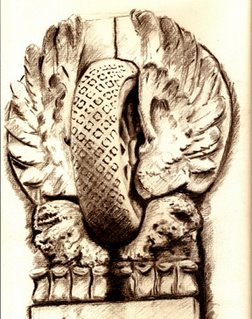
Divine intervention? Maybe. Very unique (and intriguing) column capital? Definitely. Truth be told, this column capital (located at S. Phelps and W. Boardman) is probably not really unique. It may very well be a catalogue piece that turns up in other cities across the country. When I first saw it, though, I remember thinking how cool it was. The same excitement comes over me every time I look up and discover a new detail in the city. The tops of buildings are often a great place to find bits of art and whimsy. Therefore, my answer is that Youngstown is unique because of its buildings and building details.
Of course what makes us unique is not only physical. When asked the same question, a friend answered with an exciting tale of the incredible social clubs throughout the city. What he finds exciting about Youngstown is the strong ethnic diversity and social clubs that we have managed to hold on to. The example he gave was of the Palm Café on Steel Street. Although I have never been there myself, what he described to me sounded wonderful – A weekly spit roast that draws in hoards of people to get a hearty helping of roasted pig or lamb.
I can think of loads of other places around town that have maintained their ethnic roots (think pierogi from St. Stanislaus) while inviting others to join them in celebration (think Gathering of the Irish Clans) and dozens of social clubs that have become institutions (think Avalon Gardens). So...Youngstown is unique because of its diverse associations.
If you think Youngstown is unique, please leave a post today and let us all in on your favorite little piece of it...even if you think it is only important to you. Also, if you have the chance, ask your co-workers/friends/family/bar-tender what their answer would be.
I guarantee you will learn something new and exciting.
Wednesday, November 15, 2006
The Youngstown Homestead Act of 2007 : part II
The main article begins with a roadtrip through the city guided by chief city planner, Anthony Kobak. Two other question-and-answer pieces, one with Youngstown Mayor Jay Williams and the other with Hunter Morrison, Director of the Center for Urban and Regional Studies at YSU, are also available.
An interesting policy question develops from this situation . . . How can a city create effective polices to stimulate home ownership and the local housing market?
- - -
Some cities partner with their educational institutions to provide incentives for their employees to become local homeowners. Yale University established the Yale Homebuyer Program in 1994, where employees of the university are offered $25,000 to purchase a home in certain neighborhoods. Their website chronicles the 700th home purchased as a result of this program – representing 5 percent of all homes purchased in the city.
Other cities such as Baltimore offer a laundry list of programs, such as $3,000 toward closing costs, matching grants, and loan assistance. Visiting DC recently, it was interesting to see the Live Baltimore housing program advertising on the metro.
- -
But do any cities have an education-based housing incentive program? I have not looked around if one exists, but the program might work like this:
Let’s bundle “incentives” into one category. The carrots can include closing costs, property tax abatements, grants for remodeling historic infrastructure, or straight-up cash. The following total amount of incentives would be given to any new homeowner in certain neighborhoods within the city of Youngstown if they can prove they have a diploma from an accredited university:
Bachelor’s degree: $5,000 in incentives
Master’s degree or Law Degree (JD): $15,000 in incentives
PhD or MD: $40,000 in incentives
Of course other stipulations would be added to the program to prevent abuse. Limits on how often one can purchase a house, how much is actually offered, and if the amount is provided at once, or spaced out over time, are details to be considered by the finance department.
And some may argue this is just a form of welfare for those who in the future may be higher-wage earners. That is a legitimate concern, but I wonder if a new medical doctor at St. Elizabeth’s, fresh from medical school with massive amounts of debt, would utilize this program to purchase their first house in the neighborhoods close to the hospital.
Businesses already seem to enjoy this type of investment. For expanding business expecting to grow, the city provides grants and loans to assist. Why shouldn’t the same thing happen for individuals, who in the long run, may provide tens of thousands of dollars to the city coffers in the future?
A quote from Jay Williams within the Governing article got my attention. He said “The city spends upwards of $40,000 or $50,000 for income-eligible citizens to rehabilitate their homes. We've just done that based on a first-come-first-served basis.”
So the structure for this kind of program may exist already. Maybe the incentives can be extended beyond just income-eligible citizens, and go towards degree-holding citizens as well.
A recent post on this blog praised the city of Kalamazoo for its program to reward all city school graduates with a free college education. Housing purchases in Kalamazoo are up, but more importantly, the city sent a signal to the country that it was serious about education – and that concept was picked up by the nytimes in a story this week.
Of course, we want our policies to be effective, not just headline-grabbing, but wouldn’t it be nice for the city of Youngstown be nationally known as a place that rewards its citizens for attaining education? Would it not just improve the housing market, but send a message to the region and possibly the nation that we value higher education?
- -
So would this idea work? Any thoughts?
Tuesday, November 14, 2006
The Youngstown Homestead Act of 2007 : part I
The Homestead Act of 1862, for example, awarded 160 acres of land in the American West to every family who lived on the land for five years. Another example, the GI Bill, provided mortgage reduction policies for those who served in the U.S. Military.
Halstead calls for new policies to target the ownership of financial assets, as he claims the gap between the poor and the rich in the country is widening.
He proposes one such policy, that of giving to every newborn in America $6,000 at birth as a down payment on a productive life. With compounded interest, that amount could grow to $20,000 by the time the child reaches 18 years of age, which can then be used towards college tuition, a down payment for a home, seed money for a legitimate business, or retirement savings. In a single year for all children born in America, he estimates the cost to be $24 billion dollars, a much lower amount than what is spent on farm subsidies, foreign wars, or other ballooning government-funded programs.
But what really caught my eye is his article was this statement:
This program “could also offer inner-city kids a new social contract: If they play by the rules and graduate from high school, then a pot of money will allow them to invest in their own futures. Paired with financial-literacy education in schools, such a policy can turn a culture of poverty and dependency into one of hope and opportunity.”
- - -
Let’s investigate this idea for our own city:
This gap between the rich and the poor, for both individuals and political jurisdictions, is indeed growing in the Mahoning Valley. In the latest figures from the U.S. Census’ 2005 American Community Survey, the percentage of individuals living below the poverty line in the city of Youngstown has grown to 24.3%.
This same statistical source states there are approximately 4,700 children living in the city of Youngstown less than 5 years of age. So I’m going to estimate there are about 900 children born every year that will be moving into the city limits of Youngstown. A $1,000 investment towards each child for a project like this would cost then annually about $900,000. A $2,000 investment per newborn, would cost about $1.8 million, and so forth.
Under this concept, each child in the city of Youngstown would have a corresponding account attached to their name, which they could watch increase in value as they get older. Other additional components that can be incorporated into this program include:
- The money would only be given to the student if they successfully graduate from a high school within the city limits of Youngstown by the age of nineteen. If the student does not graduate in time, the money reverts back into the system to be distributed to future newborns.
- Only one-fifth of the money in each student’s account will go directly into their pocket, for whatever purpose they choose. The rest of the money can only be used to pay for the student's tuition in universities, community colleges, and technical schools in the Mahoning Valley.
- Financial institutions, such as banks and credit unions with their headquarters in the city of Youngstown and the Mahoning Valley will be given the first opportunity to be a partner with this program.
- Students will learn about the existence of these accounts at an early age, and will be educated on the value of investing and compounding interest at various points during their schooling. If desired, students can open additional accounts with the financial institutions that administer their account, which they can have complete control over.
Of course, the details on all this are subject to change (maybe this blog for wandering thoughts will stir some additional calculations), but the central message is clear:
We need to reward students who successfully complete school, we need to support local financial institutions, we need to push students to continue their education beyond high school, and we need some programs to make Youngstown a city where families with children feel welcome to thrive.